
I-UBA-RA MT32
MONTONICO, White, Clone UBA-RA MT 32
Compiler: University of Bari and Abruzzo Regional Agricultural Development Agency.
Registered in the national grape variety registry
Official Bulletin no. 19 of 24 January 2003.
Origin of clone: Abruzzo area, Cermignano agricultural zone (province of Teramo), identified in 1986.

| FIELD OF COMPARISON |
||
|
Location (reference vineyards) |
Casacanditella area
Vittorito area |
province of Chieti province of L'Aquila |
| Vine training method | Espalier | Trained as bilateral guyot |
| Planting density (vines/ha) | 2.666 | |
| Observation period | 1998 - 2003 | |
| DISTINCTIVE FEATURES WITH RESPECT TO THE AVERAGE | |
|
Cluster: average size and length, cylindrical, small wing sometimes present, compact, medium peduncle.
|
|
| Grape:medium-large, round, color from yellow-green to tending toward amber | |
| Vigor: good |
Fertility: medium-low, below average |
|
Productivity: good for cluster and grape weight |
|
Informations
The origins of this white grape variety are not fully known. It was described in the Ampelographic Bulletin of 1875 and was mentioned by Giuseppe di Rovasenda in 1877. Sannino (1892) describes it as the most important grape variety in the province of Teramo.
It has only a limited distribution in the central Adriatic regions. It was partially abandoned in recent decades. In 1996 there were just over 14 hectares planted with Montonico. Now there are over 70, almost all in the Teramo area. This is where it was found historically, in the municipalities of Bisenti and Cermignano (Montonico di Bisenti and Poggio delle Rose-Cermignano).
The cluster is large, long, compact or very compact, cylindrical-pyramidal. It ripens late in the season, generally 11-20 October (it needs at least 1800-1900 GDD), but the harvest period may vary based on how the must will be used: earlier for sparkling wines to take advantage of its fairly good acidity.
It prefers a cool, temperate environment in soil that is not highly fertile. It has a rather inconstant growth and yield cycle.
The has a relatively low fertility level, especially in the first buds, and thus requires long pruning.
It is blended into several DOC wines. The recognition of DOC Abruzzo Montonico in 2010 marked the beginning of the production of domain name wine. It may be erroneously confused with the white Montonico of Calabria or the Montonico Pinto of Rogliano. It goes by many different names, including Trebbiano montanaro or Montanaro, Caprone, Uva racciapoluta or Roccipoluta, Ciapparone (in the Chieti area), Uva regno, Uva fermana, Bottato, Racciapollone and Trebbiano marchigiano (in nearby Marche).
The wine produced from Montonico grapes is of a more or less deep yellow color, at times with greenish highlights, medium-low alcohol content, with delicate notes of fruit and spice, slightly astringent with good body.
Repeated observations reveal that the wine is not well regarded during the first year, but becomes quite nice after one or two years of aging.
A great deal of experimentation and winery tests have revealed its characteristics as a sparkling wine, and indeed the first sparkling wine, dubbed "Cerbis", was already produced in 2000 in Bisenti.
| PHENOLOGICAL PHASE |
STAGE |
| Budding |
26/04 Late
|
| Flowering |
11/06 Late |
| Veraison |
30/08 Late |
| Ripening |
18/10 Very Late |
| SUSCEPTIBILITY TO FUNGAL DISEASES (%) |
CLONE |
| Botrytis |
40% Medium |
| Uncinula necator |
40% Medium |
| PRODUCTIVE
CHARACTERISTICS |
CLONE |
| Real fertility |
0,91 |
| Yield per trunk |
6,01 |
| Number of clusters/trunk |
13,34 |
| Average cluster weight (g) |
450 |
| Average grape weight (g) |
3,42 |
| Dormant pruning weight (g/trunk) |
800
|
| Ravaz index:
|
7,51
|
| WINE CHEMISTRY
|
CLONE |
| Sugar (° Brix)
|
18,50 |
| pH |
3,15 |
| Total Acidity (g/l) |
6,93 |
| Tartaric Acid (g/l) |
5,05 |
| Malic Acid (g/l) |
2,02
|
ORGANOLEPTIC DESCRIPTION
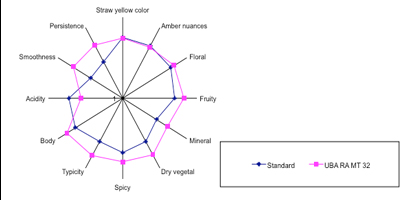
The clone is fairly productive and has rather good winemaking properties, superior to the standard of reference among local winegrowers. Montonico wines are straw yellow in color with amber highlights and characterized by a good extract and polyphenols. The sensory assessment reveals a complex bouquet featuring floral, fruity and dry vegetal notes. To the palate these wines are medium bodied, harmonious and persistent, slightly bitter. Multi-year studies show that Montonico wine improves significantly in the second year of production. The assessment of the particular basic characteristics of the Montonico grape variety, independent of the selection process, show that it can be used to produce excellent sparkling wines.
SENSORY ASSESSMENT